As AI-powered search tools like ChatGPT and Claude become household names, marketers are locked in a heated debate: Is Generative Engine Optimization (GEO) set to replace traditional Search Engine Optimization (SEO)? Some argue AI search will render organic rankings obsolete, while others insist it’s just another channel to complement existing strategies. To settle the score, we analyzed 10 websites across healthcare, cybersecurity, tech, and retail sectors, diving into 150,000 indexed pages and their March 2026 GA4 data. The findings? GEO and SEO are fundamentally different—requiring distinct optimization approaches rather than a one-size-fits-all strategy.
Content Preferences: What Resonates with AI vs. Human Searchers
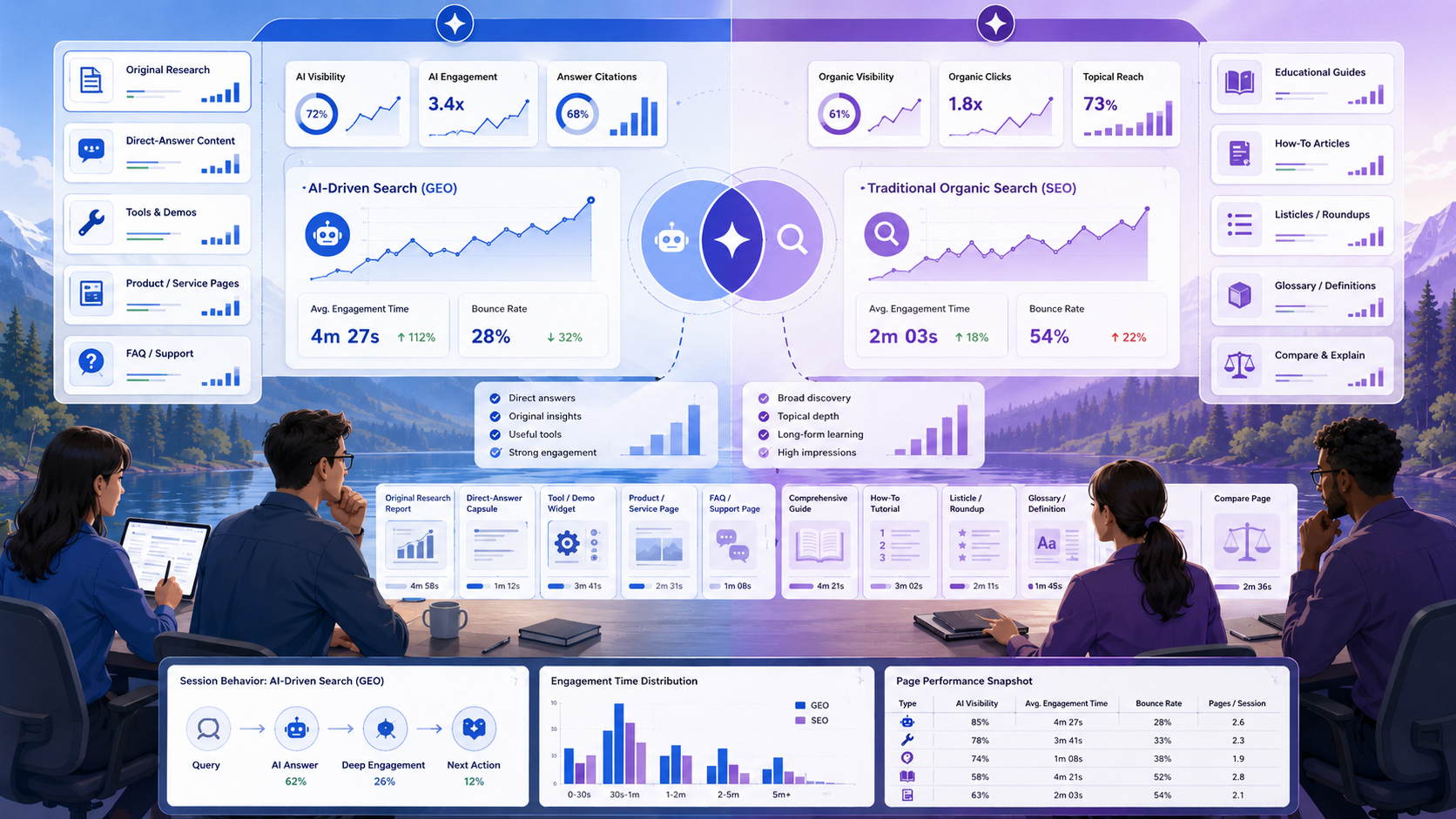
Our data reveals a clear split in content performance between AI search and organic traffic. Original research, tool-based content, and direct answer-focused pages outperform general educational content in GEO. For example, trend analysis pieces and data-driven annual reviews are cited by large language models (LLMs) 78% and 61% of the time respectively, compared to just 12% for educational guides and tutorials.
When measuring LLM sessions per 1,000 organic sessions, service and product pages lead the pack at 29.4, followed by article and content pages (23.4), FAQ and support pages (14.0), tool and demo pages (9.8), and homepages (5.6). This suggests AI systems prioritize content that directly addresses specific user needs or offers tangible value, rather than broad educational resources.

Organic Success Doesn’t Translate to LLM Traffic
One of the most surprising findings is that top-performing organic pages rarely dominate LLM traffic. Our study’s top 10 organic pages capture 55% of all organic sessions but only 29% of LLM sessions. Even more striking: 49 of the top 100 organic pages receive no LLM traffic at all.
Conversely, 14% of pages with LLM traffic recorded no organic clicks during the study period—and these pages boast above-average user engagement. This indicates AI search taps into content that human searchers might not find through traditional queries, opening up new opportunities for visibility.
User Behavior: AI-Driven Visitors Act Differently
While overall average session times are nearly identical (organic: 46.9 seconds, LLM: 47.1 seconds), the story changes when breaking down page-specific metrics. For 71% of pages with LLM traffic, AI-driven sessions are significantly shorter than organic ones. However, 27% of pages see LLM session times that are 3 to 10 times longer than organic sessions.
Page type plays a key role here. Tool and demo pages see LLM sessions last 146 seconds on average, compared to 101 seconds for organic traffic. Homepages also show longer LLM sessions (82 seconds vs. 36 seconds for organic). In contrast, service and product pages (63 seconds vs. 69 seconds) and article pages (40 seconds vs. 56 seconds) have shorter LLM sessions, likely because AI users often get quick answers before navigating deeper.
Methodology: Ensuring Reliable, Actionable Data
To ensure our findings are robust, we selected 10 websites with stable SEO fundamentals: strong core web vitals, consistent content marketing investment, and steady organic search performance. We tracked LLM traffic via GA4 channel grouping and source paths, covering major platforms like ChatGPT, Claude, Perplexity, and Copilot. Organic traffic was sourced exclusively from Google, focusing only on human visitors.
It’s important to note that LLM crawlers (such as GPTBot and ClaudeBot) make requests before client-side JavaScript loads, so these actions aren’t recorded in GA4. Our analysis focuses solely on traffic driven by users interacting with AI tools, not the crawlers themselves.
Optimizing for GEO: Tailored Strategies to Boost AI Search Visibility
Based on our research, here are four actionable strategies to optimize for GEO without neglecting SEO:
- Prioritize AI-unreplicable content: Focus on original data, proprietary research, and unique insights that LLMs can’t generate independently. If budget allows, invest in conducting new studies to create verifiable, exclusive data assets.
- Add answer capsules: For pages you want LLMs to reference, place a concise, direct answer to the core user question near the top of the page. Avoid internal links in this section to keep the response clear and focused.
- Build named interactive tools: Create or promote tools like calculators, filters, or assessors with clear, keyword-aligned names. These tools should directly answer specific user questions and provide practical, actionable value.
- Track and optimize separately: Monitor GEO and organic traffic performance on distinct pages. When planning GEO content, focus on the questions users ask AI, not just the keywords they search on Google. Pay special attention to pages with no organic clicks but high LLM engagement—these are hidden opportunities for growth.
The idea that GEO will replace SEO is a myth. Our research proves AI search and organic search serve different user needs, with unique content preferences and behavioral patterns. Instead of pitting them against each other, marketers should treat GEO as a complementary channel, developing tailored strategies to maximize visibility across both AI and traditional search platforms. By understanding these key differences, you can unlock new levels of traffic and engagement that neither channel can deliver alone.