In the era of AI-driven search, the way users access information and brands gain visibility has undergone a fundamental shift. Traditional search engine optimization (SEO) focuses on ranking web pages in "ten blue links" results, but the rise of generative AI tools like Google Gemini, ChatGPT, and Perplexity has given birth to a new optimization paradigm: Generative Engine Optimization (GEO). This article will unpack what GEO is, its origins, how it differs from traditional SEO.
Defining Generative Engine Optimization (GEO)
Generative Engine Optimization (GEO) is the practice of optimizing digital content and online presence to improve visibility in responses generated by generative AI engines and AI-powered search interfaces. Unlike traditional SEO, which targets rankings in conventional search engine results pages (SERPs), GEO’s primary goal is to ensure your content is trusted, cited, and recommended by large language models (LLMs) when synthesizing direct, conversational answers to user queries.
In simpler terms: When a user asks Google’s Search Generative Experience (AIO) or ChatGPT a question, GEO helps your content become a go-to source for the AI’s response—whether it’s quoted directly, linked to as a reference, or featured in an AI-generated overview. This is critical because over half of users now rely on AI tools instead of traditional search engines, and publishers have seen a 12–18% drop in organic traffic to informational content as AI answers become more prevalent.
The Origins of GEO
The term "Generative Engine Optimization" was first introduced in November 2023 by six researchers in an academic paper titled GEO: Generative Engine Optimization. The study highlighted a growing need to adapt optimization strategies to the AI-first search landscape, where users no longer click through multiple links but instead consume synthesized answers directly from generative engines.
To validate GEO’s effectiveness, the researchers developed GEO-BENCH—a benchmark dataset of 10,000 queries designed to test GEO techniques empirically. Their findings confirmed that targeted GEO practices significantly increased the likelihood of content being cited in AI responses, establishing GEO as a distinct yet complementary field to traditional SEO.
Since its introduction, GEO has been referred to by other terms (e.g., AI SEO, LLM Optimization, Answer Engine Optimization), but its core purpose remains consistent: optimizing for AI-driven content consumption rather than link-based rankings.
GEO vs. Traditional SEO: Key Differences
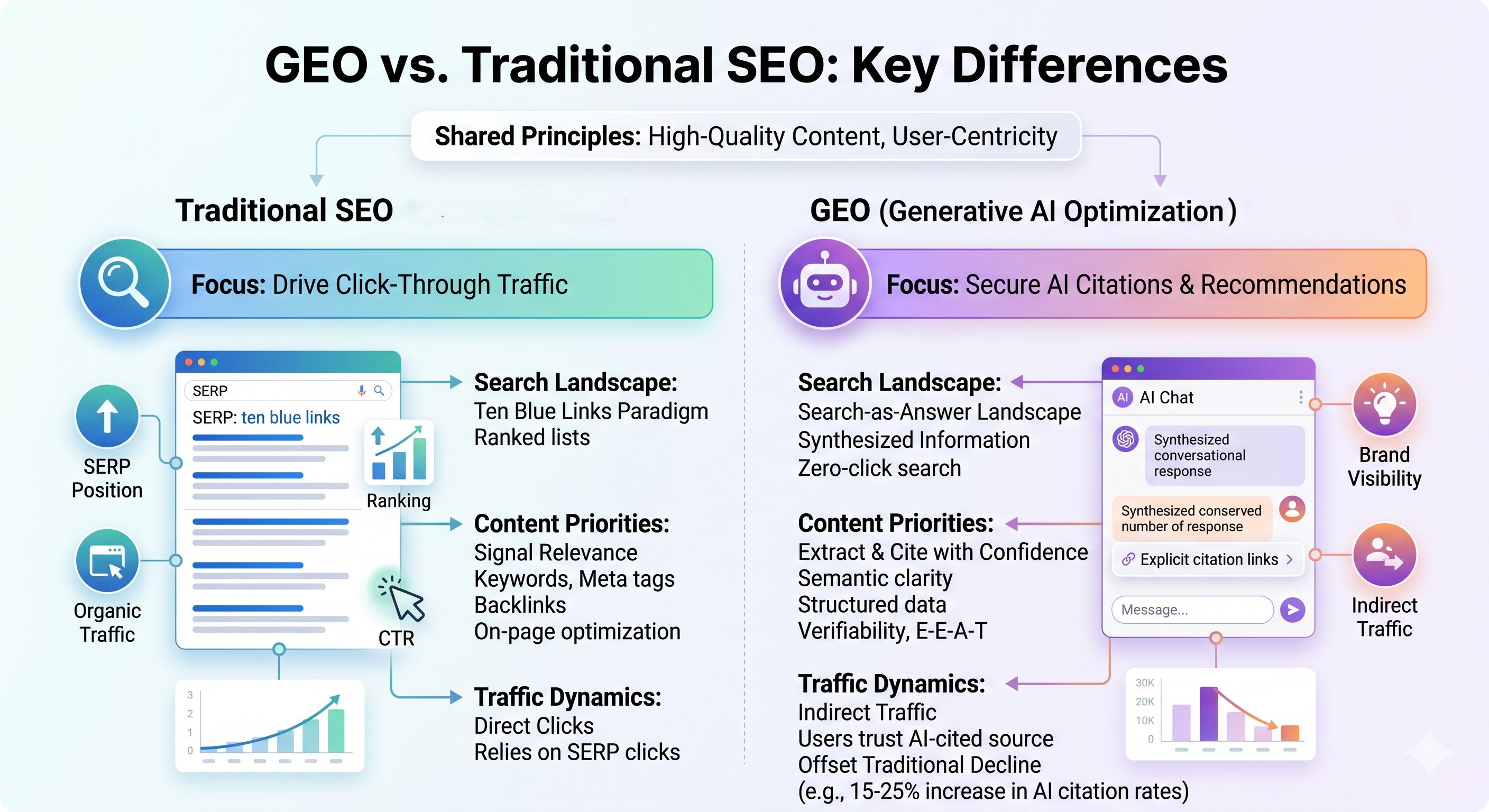
While GEO and traditional SEO share foundational principles (e.g., high-quality content, user-centricity), they diverge in critical ways. Understanding these differences is essential for crafting a holistic search strategy:
1. Optimization Goal
- Traditional SEO: Focuses on improving a web page’s ranking in SERPs to drive click-through traffic. Success is measured by positions, organic traffic, and click-through rates (CTR).
- GEO: Focuses on securing citations, mentions, or recommendations in AI-generated answers. Success is measured by AI citation rates, brand visibility in conversational responses, and indirect traffic from users who follow links in AI outputs.
2. Search Landscape
- Traditional SEO: Operates within the "ten blue links" paradigm, where search engines return ranked lists of web pages.
- GEO: Operates in a "search-as-answer" landscape, where generative engines synthesize information from multiple sources into a single, cohesive response. Users often get their answer without clicking any links (zero-click search), making citations the new currency of visibility.
3. Content Priorities
- Traditional SEO: Emphasizes keyword density, meta tags, backlinks, and on-page optimization to signal relevance to search algorithms.
- GEO: Emphasizes semantic clarity, structured data, verifiability, and E-E-A-T (Experience, Expertise, Authoritativeness, Trustworthiness)—traits that make content easy for LLMs to extract and cite with confidence.
4. Traffic Dynamics
- Traditional SEO: Relies on direct clicks from SERPs to drive traffic.
- GEO: Drives indirect traffic from users who trust an AI’s cited source and click through to learn more. Early adopters of GEO have reported 15–25% increases in AI citation rates, offsetting declines in traditional organic traffic.
Core Principles of GEO (Aligned with Google’s Guidelines)
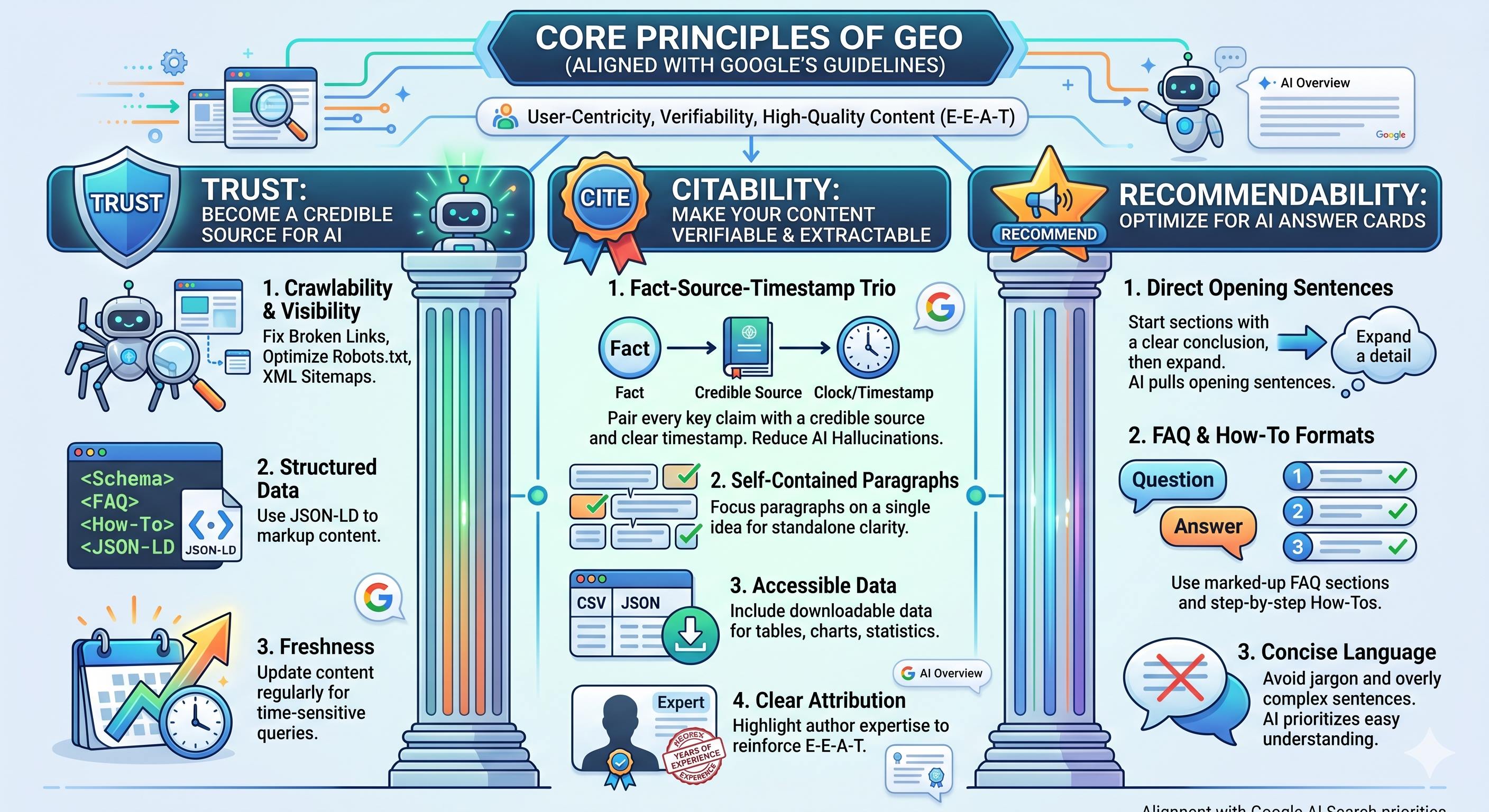
Google’s official guidelines for AI-powered search (e.g., AI Overviews) emphasize user-centricity, verifiability, and high-quality content—principles that are central to effective GEO. Below are the three foundational pillars of GEO, designed to align with Google’s E-E-A-T framework and AI search priorities:
1. Trust: Become a Credible Source for AI
For an LLM to cite your content, it must first trust your source. Trust is built through:
- Crawlability & Visibility: Ensure your website is easily crawlable by search engines and AI tools (optimize robots.txt, XML sitemaps, and fix broken links). Google’s AI systems rely on the same index as traditional search, so crawlability is a non-negotiable foundation.
- Structured Data: Use JSON-LD to markup content with schemas (e.g., FAQs, How-Tos, events, data tables). Structured data helps LLMs understand and extract information quickly, increasing the chances of citation.
- Freshness: Update content regularly, AI engines prioritize up-to-date information for time-sensitive queries.
2. Citability: Make Your Content Verifiable & Extractable
AI engines only cite content that is easy to verify and extract. To optimize for citability:
- Fact-Source-Timestamp Trio: Pair every key claim with a credible source (e.g., peer-reviewed studies, official data) and a clear timestamp. This reduces AI "hallucinations" and makes your content a reliable reference.
- Self-Contained Paragraphs: Structure paragraphs to focus on a single idea. LLMs often extract individual paragraphs for answers, so standalone clarity is critical.
- Accessible Data: Include downloadable data (e.g., CSV, JSON) for tables, charts, or statistics. This makes your content more valuable to AI engines and users alike.
- Clear Attribution: Highlight author expertise (e.g., credentials, years of experience) to reinforce E-E-A-T. AI engines prioritize content from subject-matter experts.
3. Recommendability: Optimize for AI Answer Cards
To get featured in AI answer cards (e.g., Google’s AI Overviews), optimize your content for "answer-first" delivery:
- Direct Opening Sentences: Start paragraphs or sections with a clear conclusion, then expand with details. AI engines often pull opening sentences for conversational answers.
- FAQ & How-To Formats: Use FAQ sections (marked up with Schema) and step-by-step How-Tos. These formats align with common user queries and are easily synthesized by LLMs.
- Concise Language: Avoid jargon and overly complex sentences. AI engines prioritize content that is easy to understand and translate into conversational answers.
How to Measure GEO Success (Beyond Traditional SEO Metrics)
Traditional SEO metrics (e.g., SERP position, CTR) are insufficient for measuring GEO performance. Instead, track these key metrics:
- AI Citation Rate: The percentage of AI responses to relevant queries that cite your content.
- Brand Mentions in AI Responses(AI visibility): How often your brand is mentioned (with or without a link) in AI answers.
- Indirect Traffic: Traffic from users who click through to your site from AI-generated citations (track via Google Analytics’ "Referral" segment).
- GEO-BENCH Performance: Test your content against GEO-BENCH (the 10K query benchmark) to see how it stacks up against optimized competitors.
The Future of GEO: Why It Matters for 2026 and Beyond
As Google moves toward making AI search the default experience and Gartner predicts a 26% drop in traditional search traffic by 2026 (offset by a 300% increase in AI citation demand), GEO is no longer an optional strategy—it’s a necessity. Early adopters are already seeing significant gains: content optimized for GEO is up to 40% more visible in generative search results than content relying solely on traditional SEO techniques.
The good news? If you’re already following Google’s SEO best practices (high-quality content, E-E-A-T, structured data), you have a head start. GEO is not a replacement for traditional SEO—it’s an evolution. By adapting your content to the AI-first search landscape, you can ensure your brand remains visible, credible, and discoverable as user behavior continues to shift.
Final Thoughts
Generative Engine Optimization (GEO) is the bridge between traditional SEO and the future of AI-driven search. It’s about creating content that doesn’t just rank—it’s trusted, cited, and recommended by the generative engines that are rapidly becoming the primary source of information for millions of users. By focusing on trust, citability, and recommendability, and aligning your strategy with Google’s E-E-A-T guidelines, you can position your brand for long-term success in the age of generative AI.